In May, half of LinkedIn said the ten blue links were finished. AI Mode would be the default Google by the end of 2026, websites would be obsolete, and SEO was a dead trade.
This month, Google appears to be testing the opposite. On 3 November Search Engine Roundtable reported a test removing the AI Mode button from the search bar. On 13 November it reported a second test, spotted by Glenn Gabe, with no AI Mode tab and no “ask anything” follow-up box under the AI Overview.
It is a test, not a decision, and a small one: Roundtable could not reproduce it themselves. Google tests features on tiny groups of users all the time. But the reason behind it is worth understanding, because it tells you where search is heading and what is safe to keep investing in.
Why would Google pull back its own AI?
Quick answer: Most likely money. Ads inside AI answers earn less than ads on a normal results page. Google said so on its own earnings call, and an independent study found ChatGPT ad visits earn shops far less than Google search ad visits. When the AI answer does not pay as well, the classic results page keeps its place.
On the Q3 2026 earnings call, Google’s chief business officer Philipp Schindler said the strong growth in AI Mode queries had an impact “because of the lower monetization we were seeing in AI Mode.” Search revenue came in at about US$63.4 billion against estimates near US$64.9 billion, the second quarter in a row below forecast (Marketing Dive). Total Google ad revenue still grew around 11%, so this is slower growth, not a collapse.
Google is a search engine paid for by advertising. If every search moves into an AI conversation that earns less per query, Google earns less. Testing what happens when AI Mode is less visible is a normal business question. To be fair to Google, it is also pushing the other way: it is rolling out ads in AI Mode to more countries and more queries. It is testing both doors at once.
The ChatGPT ads study
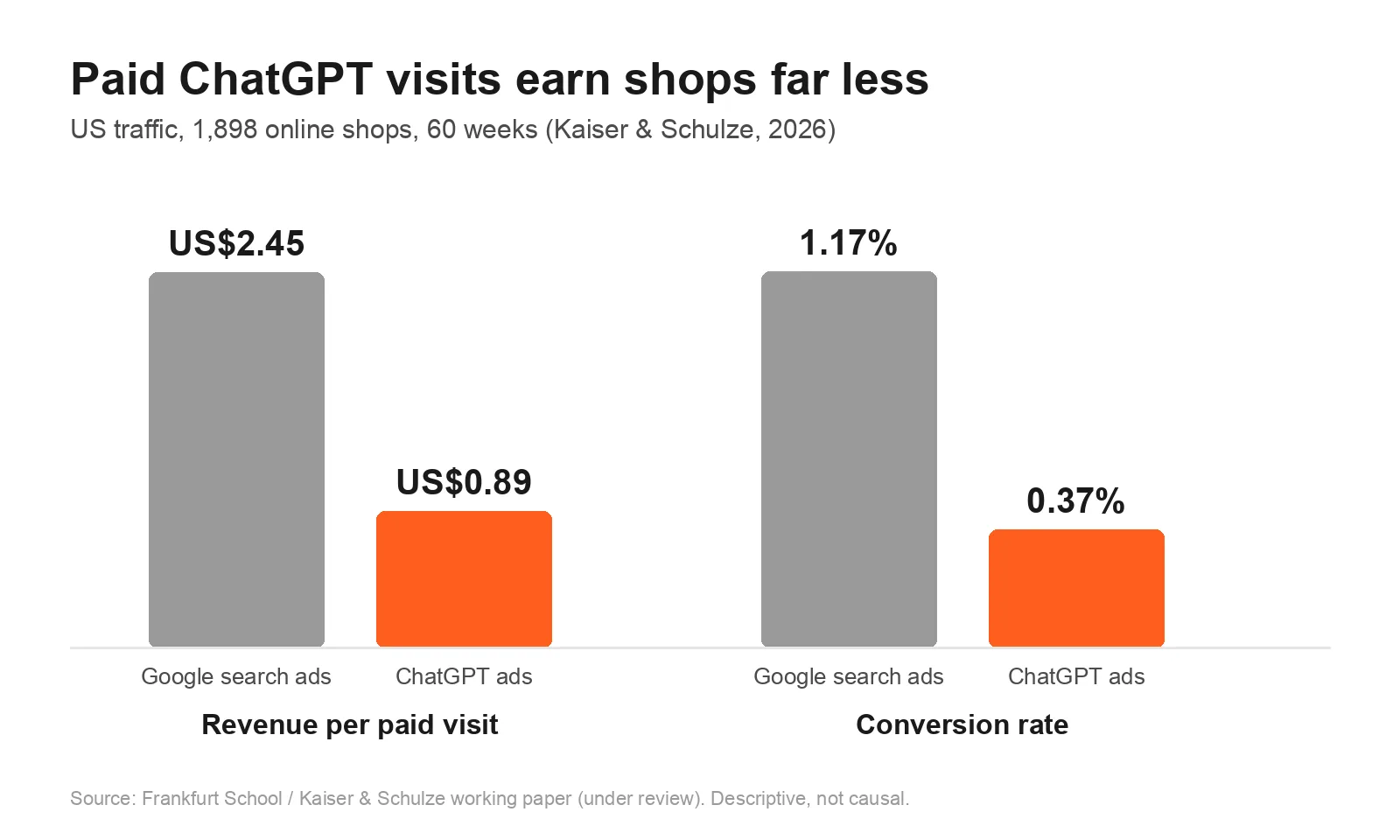
The same week, a working paper by Maximilian Kaiser and Professor Christian Schulze (Frankfurt School) looked at ChatGPT’s ad rollout. ChatGPT launched ads country by country from February 2026, so the ad-free EU served as a comparison. The study followed 1,898 online shops with around US$16 billion in yearly sales over 60 weeks. The paper is still under review.
What it found, in short:
- Visitors from ChatGPT ads performed worst on all six measures, behind Google Ads, Google organic search, direct traffic, and even ChatGPT’s own unpaid recommendations.
- In US traffic, a paid ChatGPT visit brought in about US$0.89 in revenue against US$2.45 for a paid Google search visit.
- Conversion was 0.37% for ChatGPT ad visitors against 1.17% for Google search ads.
- Free referrals from ChatGPT to shops dropped an estimated 6 to 8% after ads launched.
The authors are careful to call the ad comparison descriptive, not proof of cause, since advertisers chose to buy the ads. Still, the gap is large.
The authors’ conclusion is that more ads cannot close the gap. Each click would have to be worth far more, and the ways to do that (ads blended into the answer, heavier targeting) risk the trust that makes people use the product.
So is AI search going away?
No. And that is the honest part most “SEO is back” headlines will skip.
AI answers are not disappearing. AI Overviews still show on many searches. ChatGPT, Gemini and Perplexity are still where a growing share of people ask before they buy. ChatGPT just launched a business profile so companies can claim how they appear. Directories and review sites are showing up as cited sources in AI answers more and more.
What this test shows is narrower: nobody, not even Google, has worked out how to make AI search pay as well as the old results page. Until they do, the classic search page, with links to real websites, keeps its place. Search is turning into an ecosystem with several doors, not a single AI box that replaces everything.
What we tell clients to do
Our advice has not changed this month, and it did not change in May either. That is the point.
- Keep doing the SEO that works. Clear pages for the services you sell, fast site, good internal links, honest reviews, links from relevant sites. AI tools still have to find and retrieve answers from an index. Getting into that index and being easy to quote is SEO.
- Answer the buyer’s real questions on your own site. Price ranges, what is included, how long it takes, who it is not for. Pages that answer these get quoted by Google and by AI.
- Be present where AI looks. Google Business Profile, the main directories in your industry, the new ChatGPT business profile where you are eligible, and articles on sites that already rank for your topic.
- Track both. We watch Google rankings and AI mentions side by side every month. See our two-lane case study and why SEO is not dead in 2026.
- Ignore the panic cycle. Every few months someone announces the end of websites. Businesses that kept publishing useful pages through each of those announcements are still getting enquiries.
Frequently Asked Questions
Is Google removing AI Mode for good?
Not confirmed. These are tests on some users. Google has run tests like this for years, and some features come back. Treat it as a signal about cost, not a final decision.
Should I stop working on AI search visibility?
No. AI answers still influence buyers. Most of the work that helps you appear in AI answers (clear answers, structured pages, mentions on trusted sites) also helps Google, so it is not wasted either way.
Are ChatGPT ads worth testing for my business?
Based on the Kaiser and Schulze study, not as a first channel. Paid ChatGPT visits converted at roughly a third of the rate of Google search ads. If you have budget left after Google is working, test small and measure sales, not clicks.
Will websites become obsolete?
Not on current evidence. AI tools quote websites. If no one publishes useful pages, the AI has nothing to answer with. More on that in zero-click search in Singapore.
The verdict
AI search is real, it is growing, and it is still expensive and unproven as a business for the companies running it. Your website is not obsolete. It is the source the AI reads. Keep it useful, keep it honest, and keep going.